
The Greenland Gambit
How a “Ridiculous” Idea Exposed China’s Ambition, Europe’s Fragility, and America’s Blind Spots

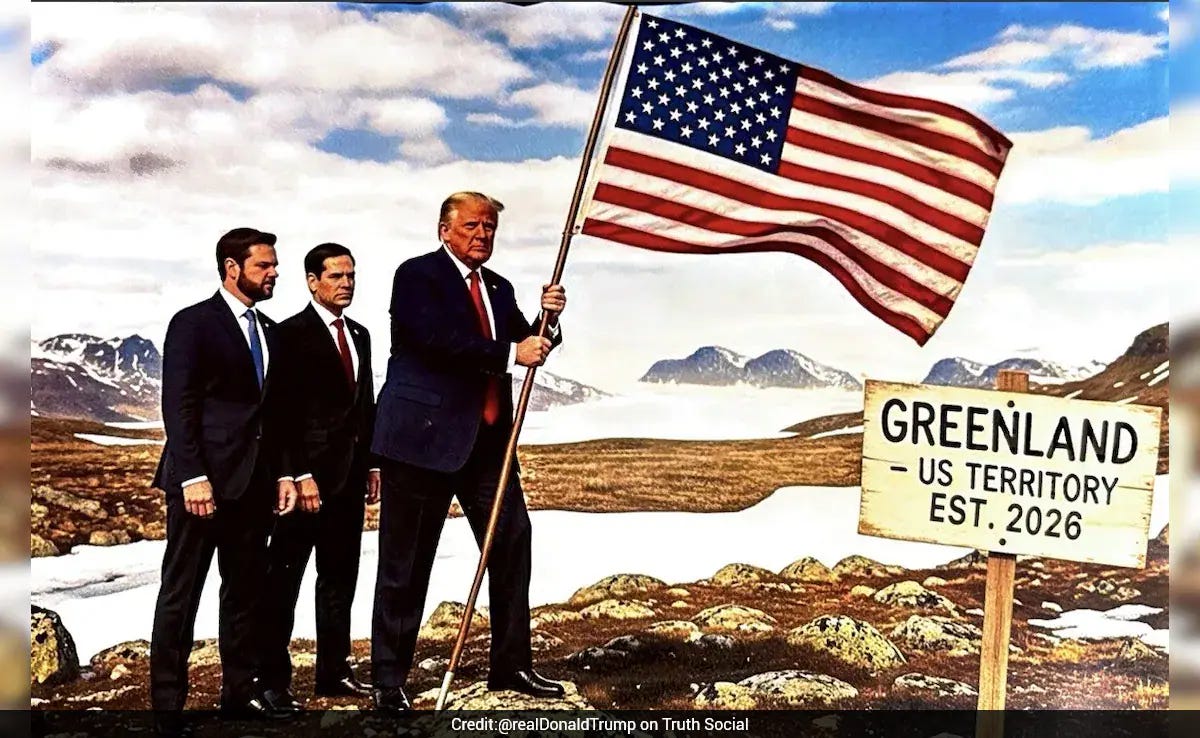
The Iceberg Everyone Pretended Was a Joke
I still remember the summer of 2019, when half the internet decided that the funniest thing they’d ever seen was the idea of America buying Greenland. My feed looked like a digital kindergarten: penguin emojis, ice jokes, photoshopped maps where the United States sprouted a giant blue appendix, headlines written by people who clearly hadn’t opened an atlas since middle school. Denmark performed a dramatic faint on the global stage, European ministers issued statements dripping with polite disbelief, and American journalists treated the whole thing like the geopolitical equivalent of watching your uncle try to Venmo a mountain.
Everyone laughed.
Everyone smirked.
Everyone performed their little performance.
And I laughed too — at first — because that’s what you do when you’ve been trained by the modern media to treat anything involving Trump as either apocalyptic or absurd, but never serious. The tone was already pre-decided for us: the orange man wants to buy an iceberg. Haha. Thread. Retweet. Move on.
But the longer I watched the coverage, the more something bothered me. The louder the jokes became, the more I wondered why nobody seemed interested in the part of the story that wasn’t funny. The part that wasn’t even new. Because somewhere beneath the noise and the memes and the diplomatic pearl-clutching lived a very old truth: America had tried to buy Greenland before — twice — and each attempt had been made by men the media still pretends were serious statesmen.
I started reading.
And then I kept reading.
And very quickly, the joke melted.
What I found was not a punchline; it was a pressure point — a glowing fault line running straight through the future of global power. The more I learned, the more surreal it became that our entire culture had shrugged this off as comic relief.
While Twitter was playing dress-up, the Arctic was opening new shipping lanes; while late-night hosts were mocking “real estate diplomacy,” China was quietly embedding itself in Greenland’s mining sector;
while Denmark acted wounded, Russia expanded its northern military bases; and while the Western press rolled its eyes, the Pentagon sharpened its focus on the precise territory everyone insisted didn’t matter.
Suddenly, the story looked very different.
Greenland wasn’t a meme. It was a mineral chest the size of a continent.
It wasn’t a punchline. It was a shield wall for North American defense.
It wasn’t absurd. It was strategic.
And the outrage that swirled around the idea only revealed something far more absurd than the offer itself: a world that has forgotten how power works, but still wants to pretend it’s qualified to comment on it.
The funniest part of 2019 wasn’t that Trump wanted Greenland.
It’s that so many people genuinely believed the idea was inherently ridiculous — as if geopolitics must follow the emotional rules of polite society, and as if the Arctic, of all places, would be governed by European feelings rather than hard reality.
What began as a curiosity for me became a kind of intellectual excavation. The deeper I dug, the clearer it became that Greenland was never the joke — the reaction was. The laughter, the outrage, the think pieces written by people who confused diplomacy with theater, all of it revealed a civilization that still wants empires without saying the word “empire,” resources without acknowledging where they come from, and security without understanding the geography required to maintain it.
This essay is my attempt to stitch the threads together — the comedy, the history, the politics, the panic, the minerals, the melting ice, the China problem, the European fragility, the American instinct, and the quiet truth that sometimes the story people mock the loudest is the one they least understand.
This is the Greenland that wasn’t a meme.
This is the iceberg everyone pretended was a joke — until the world changed around it.
And this is the part where the laughter stops, and the map finally comes into focus.
Chapter One — The Day Trump Looked North and Saw the Future
I’ve always believed that the fastest way to expose the intellectual laziness of modern commentary is to watch how people react when confronted with a geopolitical idea they don’t understand. In 2019, when Donald Trump floated the possibility of buying Greenland, the reaction was so predictably stupid that it almost became comforting. It was like watching muscle memory — not America’s, but the media’s. Someone said the magic word “Trump,” and immediately every critical faculty in the Western hemisphere shut down.
What followed was a digital circus:
Penguin emojis.
Iceberg memes.
Journalists auditioning for Saturday Night Live from their Twitter accounts.
Late-night hosts collapsing under the weight of their own predictable punchlines.
Denmark staged a theatrical swoon.
Europe acted like someone had suggested auctioning Florence.
American progressives reacted as if the question itself violated the Geneva Conventions.
Meanwhile, the only adults in the room — military planners, geostrategists, and China watchers — went very, very quiet.
Because here’s the piece almost nobody mentioned while the internet was busy slapping snowman GIFs onto the news:
Trump wasn’t the first American president to want Greenland.
He was the third.
Truman tried to buy it in 1946 for $100 million in gold.
Andrew Johnson’s administration explored the idea in 1867 — the same year we bought Alaska.
Both times, the logic was the same:
Greenland is a strategic asset, not a joke.
If Harry Truman had tweeted about buying Greenland, history books would call it foresight.
When Trump said it, the media called it a meltdown.
That gap — between reality and performance — is the real story.
Why Trump Looked North
There’s a fundamental difference in how Americans and Europeans perceive land.
Europe sees land as memory: ancestral, emotional, historical. They see a glacier and think “Instagram aesthetic.” They see territory and think “heritage.”
Americans, by contrast, see land as possibility — a resource, an investment, a future. Americans see a glacier and think “minerals.” And Trump, in particular, sees a glacier and thinks, “Let’s negotiate.”
It’s not insanity.
It’s not chaos.
It’s American pragmatism in its purest form.
And in 2019, Trump was responding to something real: the Arctic was becoming the next geopolitical hotspot whether Europe liked the topic or not.
Why Greenland Matters — the 90-second geopolitical explanation
For anyone reading this who has never thought about Arctic politics (which is most people), here is the blunt truth:
Greenland is one of the most strategically important pieces of land on Earth.
Not for its population.
Not for its culture.
For what lies above it, beneath it, and around it.
It sits at the gateway between the North Atlantic and the Arctic Ocean.
Whoever controls Greenland influences Arctic shipping lanes — the new frontier of global trade.It is home to rare earth minerals essential for modern tech and defense.
China currently dominates global processing. Access to Greenland would supercharge that dominance.It hosts Thule Air Base, one of the pillars of U.S. missile defense and space surveillance.
Lose influence over Greenland, and you compromise part of your northern shield.As Arctic ice retreats, new shipping routes emerge.
These routes cut transit times between Asia and Europe dramatically — and whoever controls them controls the arteries of 21st-century commerce.
This is why American strategists have quietly obsessed over Greenland for decades.
This is why China has been courting Greenland since the early 2000s.
This is why Russia has militarized its entire Arctic coastline.
This is why Denmark panic-reacted in 2019.
And this is why Trump’s offer — blunt, unfiltered, undiplomatic — was not actually crazy.
It was logical.
The Real Joke Wasn’t Trump — It Was the Commentary Class
The people who reacted most unhinged were, ironically, the people who know the least about geopolitics: Twitter influencers, European bureaucrats, and American journalists who mistake snark for analysis.
While they were composing their fifteenth “Trump wants to buy a snowball” joke, China was:
drafting Arctic policy white papers
calling itself a “near-Arctic nation” (an absurdity treated seriously in Beijing)
offering to build airports in Greenland
positioning itself for mining deals
investing in Arctic research
expanding its icebreaker fleet
While Western journalists were tweeting penguin emojis, China was literally preparing to dig.
That’s the part the memes left out.
You can laugh at Trump’s language, his delivery, his timing, even his audacity.
But you cannot laugh at the map — and the map is unforgiving.
Trump saw something real.
The media saw an opportunity to feel clever.
Europe saw a chance to feel offended.
China saw a power vacuum.
Guess which one will matter in 20 years?
Why Trump’s Instinct Wasn’t Madness — It Was Pattern Recognition
Trump comes from real estate. Love him or hate him, the man knows how to value land. He understands leverage, ownership, future appreciation, scarcity. To him, Greenland wasn’t a symbol — it was an asset.
Geopolitics is real estate with armies.
Countries buy, sell, trade, lease, negotiate, and secure land all the time — just not on Twitter.
The Louisiana Purchase was mocked.
Alaska was mocked.
Both became cornerstones of American power.
History’s initial reaction is almost always wrong when the idea is new.
So the real question is not
“Why did Trump ask?”
but
“Why did everyone else lose their minds over the fact that he did?”
Because what Trump said out loud, other leaders only say in classified briefings.
The First Lesson of Great Power Strategy
If something is valuable, someone will try to acquire it.
If someone tries to acquire it, others will try to stop them.
If you mock the process, you will be outrun by those who understand it.
Greenland is not a joke.
It is a keystone of the North.
And 2019 was the moment when the world accidentally revealed who still thinks in strategy — and who thinks in hashtags.
